Countdown: 16 Days

Entry #26: To view my blog’s first entry scroll down to ‘Entry # 1’. Sorry for the inconvenience, I will eventually figure out how to reverse entry order.

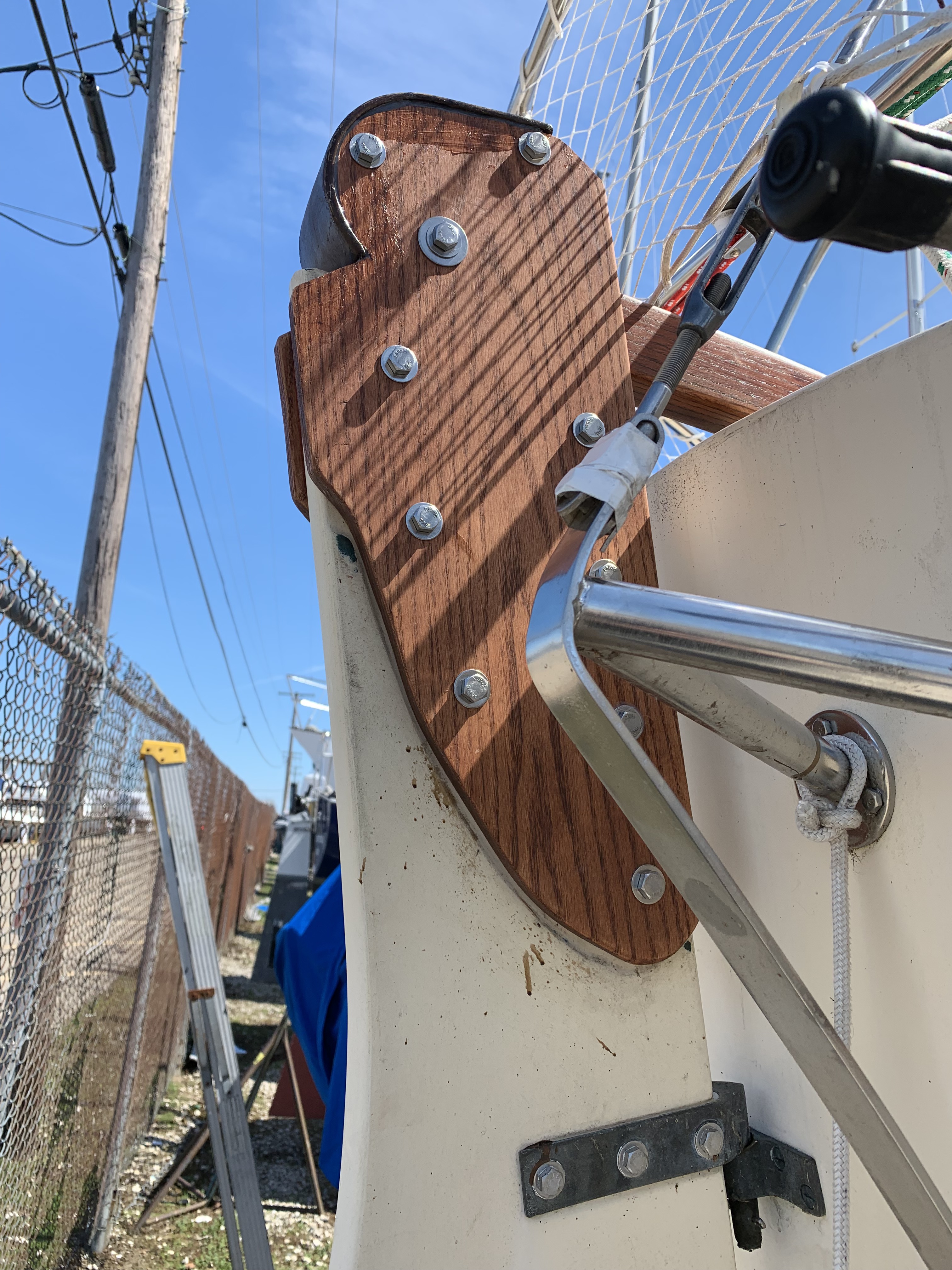
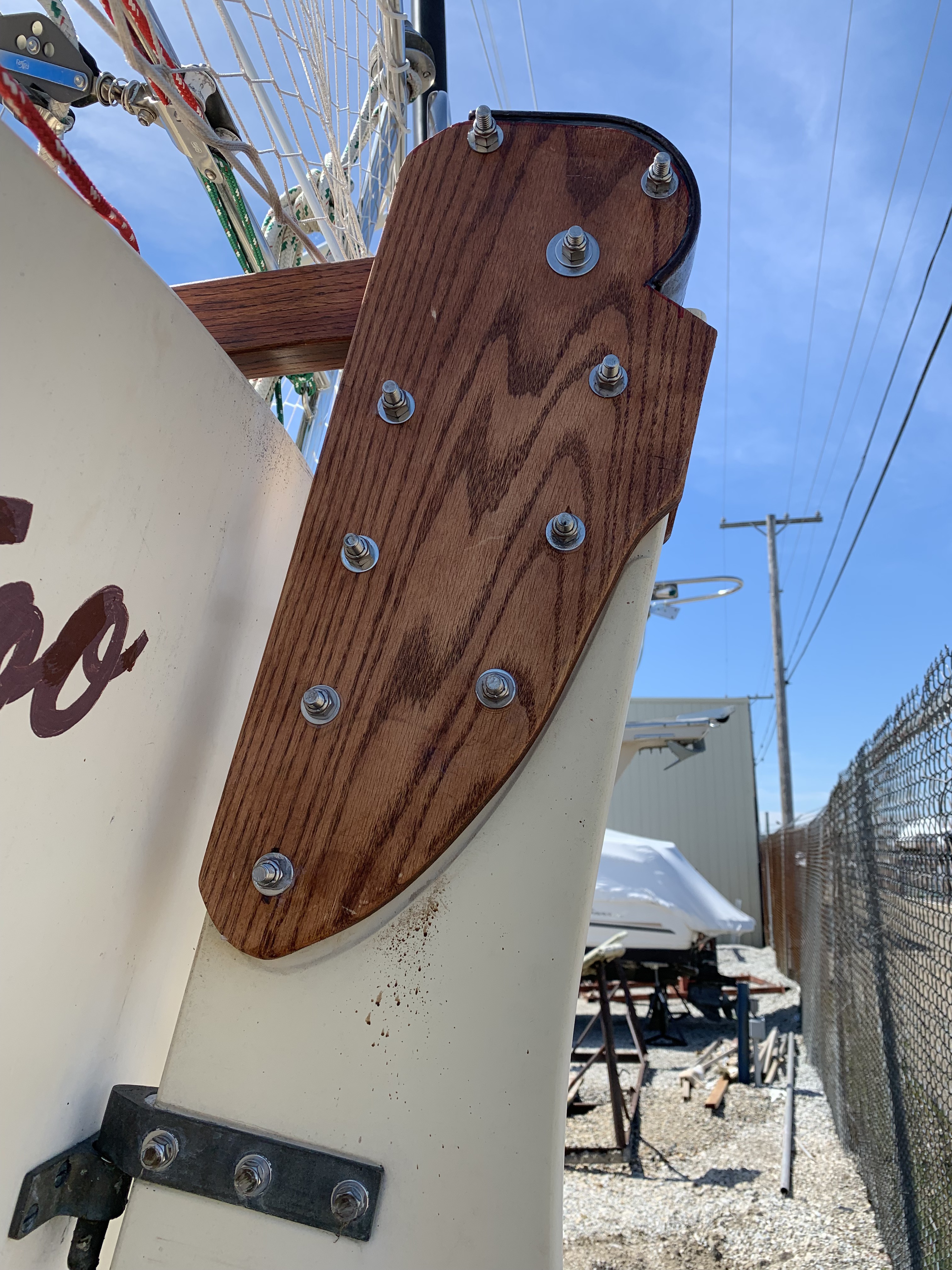
Rebuilt tiller with clutch and rudder (oak) stanchions.

Today I completed head installation with pump out capability meeting Canadian regulatory compliance. If I have time, I plan to fully enclose the toilette from view.

I also installed the Watchman II Aqualarm and Simrad TP22 Auto Pilot power plug in. Both have yet to be wired for power.

I also completed installing latches to secure my three door panels. Both the sliding hatch and door panels will need to be re-stained. With the hatch and door panels in full enclosure, I’m not happy with potential water intrusion. I’m thinking about ways to improve water intrusion integrity. I have a solution in mind, its’ simply a matter of execution and time.

Side Note: Thank goodness I picked up my mother for Easter. When I tried to use my new NEXUS pass I found out I forgot to activate it! We ended up being stopped, sent for interview while my car was being searched. I activated my pass this morning.

Picked up three (3) SOLAS Red Parachute Signal Rocket flares and four (4) charts _ Charts 14883, 14884, 14822 and 14848. Tonights’ reading material.

All in all its been a very productive week since my last entry.

NEXUS Approval

Entry # 25

Drove to Port Huron for my interview yesterday. Again, the NEXUS Pass is part of a Trusted Traveller Program run jointly by the Canadian and US governments. I eventually found the NEXUS office located indiscreetly beneath the Blue Water Bridge. Literally! As you enter the front entrance there were written instructions posted to buzz and to state the time of my appointment. The steel doors then opened and I entered a long concrete hallway with cameras following me. I felt I was in a bomb shelter. There was an elevator door at the end of the hallway with instructions posted to go to the second floor. After signing in, I was asked for my passport, drivers license, birth certificate and visa. While one officer took my credentials and walked off two other officers began to give me detailed instructions on reporting protocol including the need to acquire an app for my I-phone and also where I will need to go afterwards for a retina scan. I found out that my NEXUS Pass will also serve as TSA pre-check and Global Entry at airports. After about forty-five minutes of instruction, I was finger printed and my picture was taken. I should have my card in a weeks time. Another check-off from my ‘Moose Be Done’ list.

Update

Entry # 24 – To view my blog’s first entry scroll down to ‘Entry # 1’. Sorry for the inconvenience, I will eventually figure out how to reverse entry order.

It’s been awhile and I thought I’d give bullet updates on the following…

+ Over the past week, I’ve been working on installing a Head System to ensure compliance with Canadian regulations. Installation is almost complete. I have the toilette secured; discharge ‘inlet’ hose from toilet to holding tank connected; holding tank in place and secured; discharge ‘outlet’ hose from holding tank to deck connected; and, vent hose from holding tank to deck connected. I still need to connect a water inlet hose to complete installation. I plan to draw water from the lake through the hull. The hull inlet fixture is already in place. I just need to procure a fixture-to-hose adaptor (Ace Hardware or Home Depot?). I may have it all completed before Saturdays’ Michigan Spring Football game! Not bad for a guy who as a young adult didn’t know the difference between a Philips and a Flat Head screw driver!

+ Poseidon bow attachment project remains incomplete. I am still tweeking the bend angle of the steel brace to the bow sprit. If I do this right in addition to firmly securing Poseidon this brace will also serve to reinforce the 4′ wooden bow sprit.

+ Great news! My NEXUS pass interview is scheduled for Monday in Port Huron.

+ Installation and assembly of Rudder Wood Stanchions (I fabricated) and Tiller remains incomplete. However, good progress is being made and depending on weather, I hope to have this project completed next week.

+ I may have mentioned that I plan to have on board an old VHF Marine Transceiver (Model IC-M100) as back-up. The connector is unique and until recently I was unsuccessful in finding a power connector to plug it in. Good news! A friend of mine found a company that carries the connector! Thanks Gary. I got the connector the other day and it fits perfectly. I will now need to have it wired. I plan to attach my back-up antennae to it and have a back-up communication capability in readiness!

+ I plan to use my tiller NAVICO TP 1800 Auto Pilot as primary. However, given high failure rates with auto pilots, a back-up for long distance sailing has been highly recommended. Given the length of my trip and long days under sail, I agree. Unfortunately I found my auto-pilot model is no longer in production. After some research, I ordered a spanking new Simrad TP22 Auto-Pilot (for back-up). As suspected though its design duplicates my old auto pilot, the plug-in connector is different! This will require installing a new connector. Another hole in my boat!

Note: Though I may now know the difference between a Phillips and Flat Head screw driver, I fall short in both knowledge and confidence in anything to do with electrical wiring! I will need to find a reasonable electrician to connect my auto-pilot and VHF (back-up) radio.

+ Yesterday, I purchased on-line my Welland Canal Passage Tickets. So now I have no choice and am committed!;) A fee of $30 (Can) is charged for each lock passage and there are (8) locks! By purchasing on-line I was able to save $80 total! A one-way passage through all 8 locks takes a full day. The Canadian government requires adding ONE CREW going DOWN the locks from Lake Erie to Lake Ontario. On my return, I will need to add TWO CREW going back UP! As I am sailing solo, this presents a problem.

+ As part of GLSSs’ Required Equipment List, I ordered three (3) U.S.C.G. approved Parachute Flares. In addition, I went ahead and purchased a U.S.C.G. approved SOS Distress Light Electronic Flare with Distress Flag. This device is intended to meet and replace the need for three (3) distress flares.

+ I’m awaiting the arrival of four (4) Marine Charts to supplement the few old marine charts I kept in the closet the last few decades. See Mary, aren’t you glad I didn’t throw them out! The new charts include: Duluth Port, Sault Saint Marie & Saint Mary’s River (2) and Detroit River. Though my Garmin 942 Chart Plotter will be my primary navigational resource, I plan to utilize my charts in case of electronic failure.

That’s it for now. With 25 days remaining prior to my scheduled embarking date, I have a lot on my platter left to complete. Thanks everyone.

GLSS Safety Seminar

Entry # 23 – To view my blog’s first entry scroll down to ‘Entry # 1’. Sorry for the inconvenience, I will eventually figure out how to reverse entry order.

With spring weather breaking, I spent Wednesday working on the boat with the help of a colleague. We removed the shrink wrap; assembled the radar defector and discussed the best location for it; and, talked through the head system and how was I going to secure the holding tank. Finally, we drilled the hole to secure Poseidon to the bow. We both thought the bow to be a structural support area. However, we were surprised to find that the fiberglass was only about a ½” thick in the area I planned to bolt Poseidon. I had thought it would be much thicker. I found the hull thickness where I installed the new transducer was over 1 ½”. I decided to purchase ‘steel’ reinforcement plates for either side of the fiberglass and then bolt Poseidon to the bow. I will be attaching a picture when completed.

That evening I went to the Great Lakes Yacht Club to attend the GLSS Safety presentation and met Dan Pavlat. Dan is a member of the Great Lakes Singlehanded Society and, he and Mike Spence have been mentoring me in preparation for the Trans-Superior. Dan introduced me to a number of GLSS Board members and sailors. In addition to Michigan, attendees came from Ohio, Illinois and Ontario. One presentator had successfully completed over 41 solo distance challenges! Another presenter had completed every Port Huron to Mackinaw Race singlehandedly since the 80’s! Both very impressive. I met one sailor who had recently set the singlehanded record for sailing non-stop from Chicago to Buffalo. For some reason he seemed very interested in my attempt this summer. Hmm…please Guinness approve my application. In the end, the people I met where very knowledgeable and competitive in a good way. I found the meeting very informative. When I got home, I made additions to my ‘Moose Be Done’ list. All in all what a great group of people.

As Big as Mount Holly

Entry # 22

This morning I began drafting a letter of introduction to submit with my sailing resume to the Great Lakes Singlehanded Society. Naturally as I gathered my thoughts I became inundated with memories. In a moment of enthusiasm, I just have to pause and share a related memory. It was my experience crossing the Gulf of Saint Lawrence from Cape Breton Island, Nova Scotia to Newfoundland. It was a beautiful day in August – warm with blue skies. The winds were blowing 30-35 mph. You could see a line of clouds on the extreme horizon and I can recall having heard that there was an Atlantic storm to the east. I was on deck standing on the bow of the vessel looking ahead and holding unto the handrails tightly as we headed in a northwesterly direction. I was the only one enjoying the deck, the wind and sea spray hitting against my face. The seas in front were like small mountains as the vessel drove down the trough of one wave then rise up the oncoming next wave. I’ve never experienced seas so big. It was awe inspiring. I couldn’t explain why, but in the moment, I sensed something. I turned looking upward over my shoulder towards the bridge only to meet the eyes of the captain. The captain was looking at me and we were both smiling. I felt a moment of jealousy. I thought about walking up to the bridge and offering my services right then and there. Obviously, I’ve never forgotten those feelings of exhilaration.

As a side note: For those of you who may be familiar, the seas appeared bigger than the Pine Knob or Mount Holly ski slopes! Honestly! I’ve raced in boats with the tops of spars 30+ feet disappear between waves and we would be no more than a couple of hundred feet apart! Those seas on my way to Newfoundland were a whole lot bigger. I currently have a smile on my face thinking about it.

Rudder Reinforcement Plates

Entry # 21

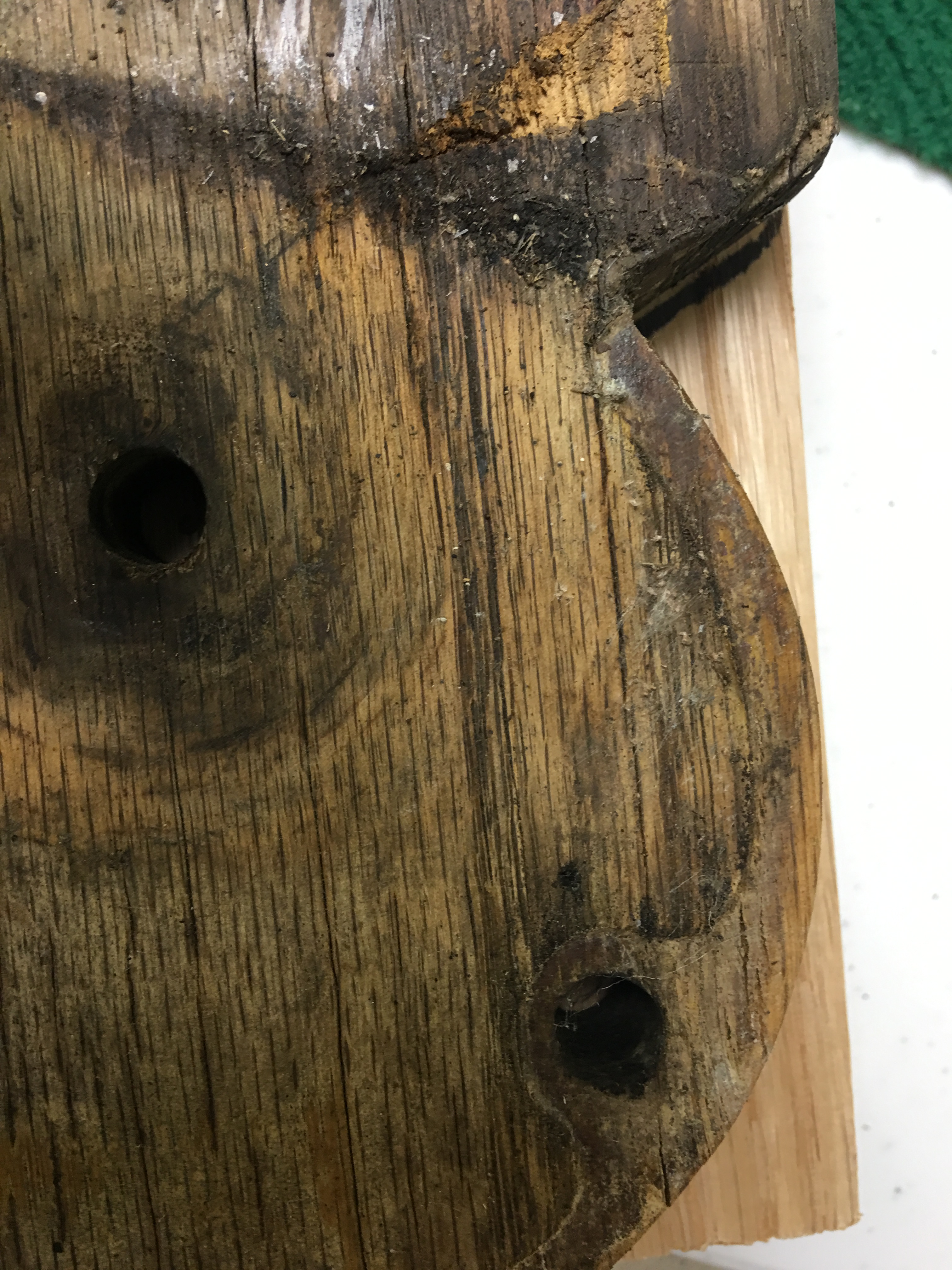
In Entry # 16, I mentioned that I felt a little uneasiness last summer with the give I felt at the helm while under sail. Not unlike the looseness one feels while steering a car with worn out ball joints. So last fall I purchased a beautiful new tiller made of oak and mahogany with the intention of replacing the old one. Finally, with the weather easing last weekend, I removed my tiller and the two reinforcement plates that were bolted on either side of my tiller (top) and fiberglass rudder (bottom). Wow, take a look at what I found in regard to the condition of my reinforcement plates _

Port Side Rudder Reinforcement Plate
Starboard Side Rudder Reinforcement Plate

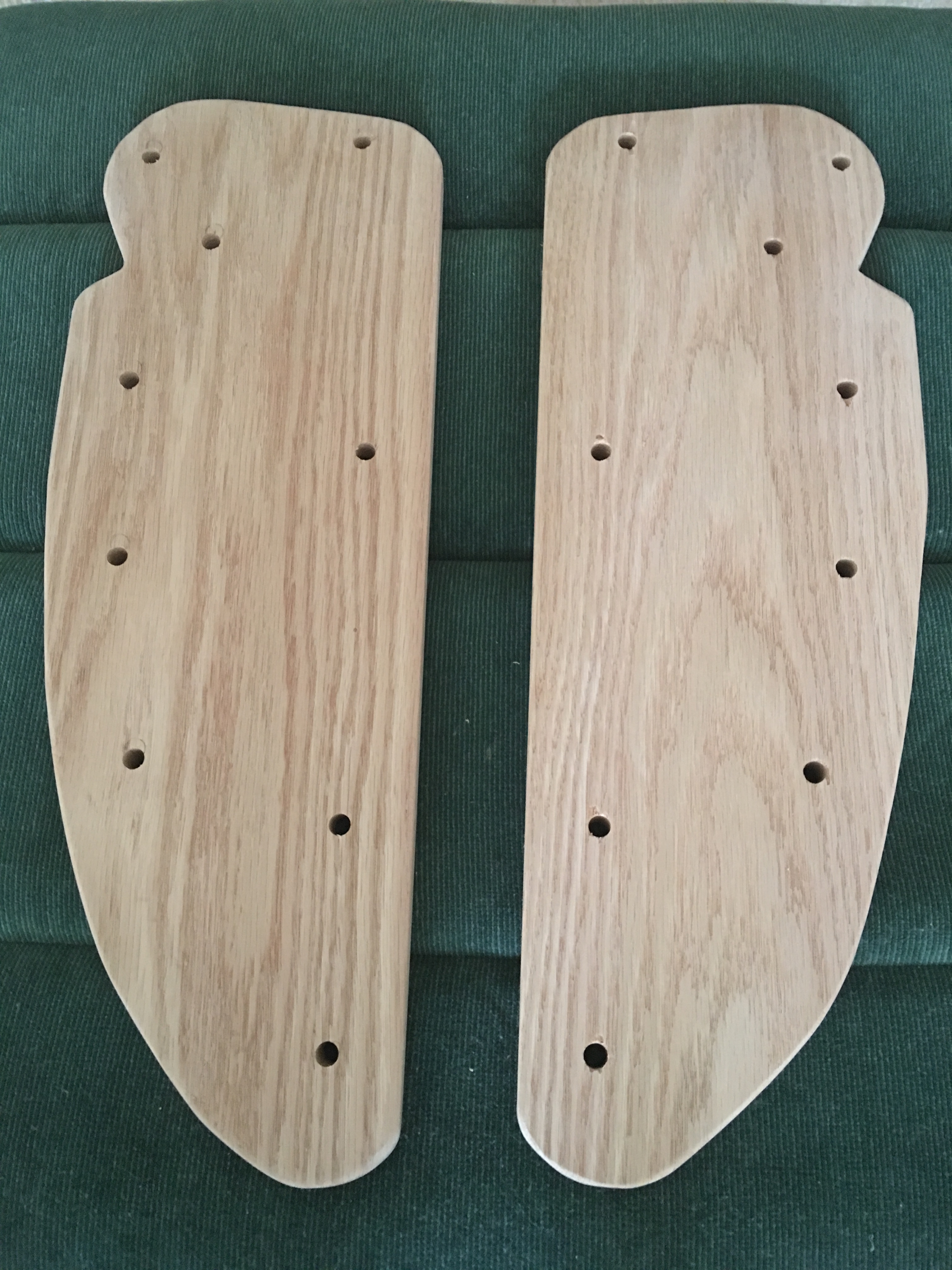
I found the inside of both plates mildewed, portions rotting and splitting. No wonder there was give and take with the helm! It is very unlikely this tiller assembly would have lasted through a single heavy sea episode let alone a three month passage. I proceeded to buy a piece of oak this week and just completed shaping reinforcement plate replacements.

Replacement Starboard & Port Rudder Reinforcement Plates nearly ready to be stained.

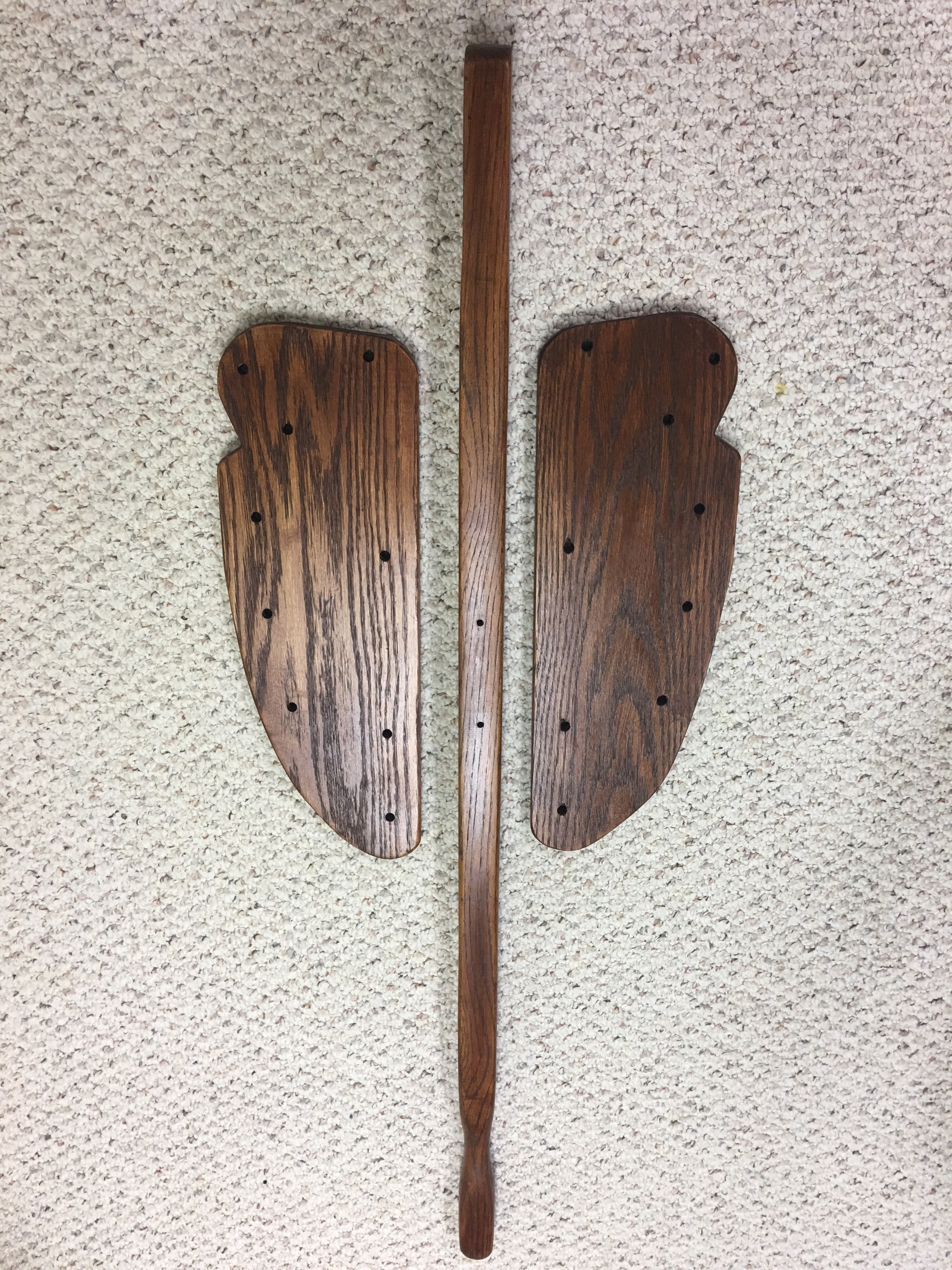
I completed sanding the original tiller. All signs of wear were aesthetic. Unlike the stanchions, there were no soft spots or pieces of wood missing. And cracks were found to be on the surface of the tiller only and were easily removed with sanding. The tiller is solid!

I applied four coats of wood stain for a deep rich finish. ‘Never Too Lates’ reworked tiller assembly is ready for installation _


Lake Michigan PHRF Certification

Entry # 19

I received official notification of Never Too Lates’ PHRF certification last night. A summary of handicap ratings include:

HCP: 306 ____ NSHCP: 321 ____ DHCP: 303

As explained in an earlier entry, a PHRF (Performance Handicap Racing Fleet) is the handicapping system used for yacht racing when there are different sailboats competing. Not unlike handicapping a Corvette against an F-150. In this case, Never Too Late would be considered a pick-up truck. The particular PHRF ratings I am most interested in are DHCP and NSHCP. The former rating is assigned for ‘distance’ racing and the latter is assigned to you when not using a spinnaker sail. It will be interesting which rating is assigned to Never Too Late for the Trans-Superior.

Personal Readiness Strategy

Entry # 18

Body & Mind: I’ve recently joined a nearby health club and have begun working out. My focus is to build up stamina and upper body strength for hoisting the sails and raising anchor. With the weather temperatures beginning to rise I also plan to begin walking and biking routines. I don’t think walking the dogs suffices.

Additionally, last week I began to reduce (ween) my consumption of alcohol. My weekly consumption has averaged around 2-3 beers and 1-2 glasses of red wine and an Old Fashioned or Jameson or Makers (only one!). I’ve decided to cut out beer and the hard stuff completely. (Note: But not forever!)

I will also be focusing on my nutrition and re-establishing my low carbohydrate program successfully undertaken prior to hiking the Inca trails in the Andes. Note: Never should have taken a cooking class in Tuscany with my Italian wife. Low carbohydrate meals pose my greatest challenge!

Reduction in alcohol consumption and an improved nutrition program should also help with my mental clarity and focus. And in general, I would hope my active lifestyle is serving to exercise my mental health and physical readiness.

Nothing exotic just an unstressful, thoughtful and moderate approach to intake and choosing a lifestyle that should be sustainable.

Information & Knowledge – Reading material, Expert Advice, Training: I’d like to begin by sharing an experience_ In early May of 2016 and at the young age of 67, I was introduced to kayaking on the Canadian side of Lake Superior by a friend of mine who had 18 years of kayaking experience. I can tell you from first hand experience and with little exaggeration that Superior water is ice cold in May. (I’m reminded of a Bill Cosby Niagara Falls story!). That summer I kayaked perhaps a dozen times mostly on inland lakes but also once at Metro Beach on Lake St. Clair. The following year, my friend and I made a trip north to kayak off the shores of Lake Superior. It was around noon when we arrived to where we planned to put our kayaks in. I looked at the 4-6 foot waves coming an onshore (WSW) 15-18 mph wind. I concluded it was going to build. I used my better judgement deciding not to go out. I only had a year of relatively smooth water kayaking experience and the size of the breaking surf in Lake Superior open waters was more than I was willing to experience at the time. My friend – again with 18 years of serious kayaking that included overnight(s) and heavier seas – showed disappointment. He suggested that he go out alone and head into the surf towards an island about 300 yards from shore then loop back. The island was less maybe an 1/4 of a mile west of where we stood. The entire trip should take 20-25 minutes at most. And because it would be only 25 minutes and in my sight, my friend decided not to take his standard technical gadgets 9GPS for example). He put on his wet suit, life jacket, hat and gloves and embarked while I stood watching.

Before I complete my story, allow me to take a moment to describe my dear friend and kayak instructor who I knew in high school and only recently re-acquainted through a mutual friend. Picture my friend as a brilliant tech geek, engineering graduate with impressive but acquired athletic skills. Following high school, I learned he had worked to address his physical awkwardness earning a karate black belt, only learning to swim in his early 60’s, avid long distance bicyclist and (as mentioned) a very accomplished kayaker. I found his athletic achievements were realized through research, manuals, training, rehearsing and depending on technology. With the possible exception of karate, each activity was religiously supported with the latest electronic device to monitor _ heart beat, body temperature, breathing rate, wind speed, determine location (GPS), direction/heading, speed, camera, vhf marine radio, flashlight, pocket knife, etc. I marvelled at his athletic and physical accomplishments. Now back to our 20 minute kayak experience….

My friend first paddled back and forth in front of me for a few minutes and then headed west into the building surf towards the island. It took him 15 minutes before he reached the island on the west side of the bay. Throughout he looked comfortable, in control and by his facial expression he was enjoying himself. He stayed in the calm by the island for a few moments before heading back. It took him less than 5 minutes before he was 100 yards out just abreast of me. But instead of heading in to where he had originally embarked, my friend continued kayaking past east towards the lee side of the bay. I won’t side track my blog content to detail what took place over the next 8 hours, let me just share that the U.S. Coast Guard dropped my friend off safe!

Lesson(s) learned? It is important to remain true to yourself and stick with what has made you successful. Perhaps on a bigger picture, reliance on too technology can be counter productive and not serve in one’s best interest. As happened here, ‘total’ dependance on technology led my friend to overlook inherently built capabilities. Later that evening after my friend had calmed down to relative normality, I asked him, “Why didn’t you come in as we agreed?” He replied, “I got dis-oriented. didn’t see you and didn’t have my GPS!”

“Whenever I head out, I look for reference points to recognize features such as tree line, branch bias and other. However, that doesn’t work in the fog! I’m glad I didn’t have to call your wife.” I said with a smile. We both had another one.

OK, long winded approach to the following personal preparation effort _

Reading Material: When I first purchased Never Too Late, I had briefly perused the PS Flicka Owners Manual for hull number (MC number & registration) and, to look up the proper procedure to stepping the mast up. (I am currently reading the owners manual – front to back – with a bit more attentiveness). Additionally, I have a boat load (pun?) of manuals to go through for the following recently acquired ‘aides’ _ a Uniden VHF Marine Radio, a SpotX 2 way satellite messenger, and a portable DVR. How safe can you be meeting equipment requirements but perhaps lack proficiency in their use?

Serving as great falling asleep reading, I recently have re-read or in the process of reading the following _

__ How To Read Water, Tristan Gooley

__ The Hidden Messages in Water, Masaru Emoto

__ Night Sky, A Field Guide To The Constellations, Jonathan Poppele

__ The Natural Navigator, Tristan Gooley

__ The True Power of Water, Masaru Emoto

__ Complete Survival Manual, Michael Sweeney

__ Advanced First Aide & Emergency Care, The American National Red Cross

__ Navigation Rules & Regulations Handbook, United States Coast Guard

__ The Racing Rules of Sailing (2017-2020), US Sailing

I am planning to bring a few along for reference.

Expert Advice and Training: I cannot overstate the value as a resource and my appreciation to the sailors, organizations, societies and experts who continue to share their knowledge and expertise. The information I have gathered has been invaluable in my preparation. While I continue to add to my ‘Moose Be Done’ checklist, I have been able to work it down to below three digits. The latest add was from a recommendation to secure my manual bilge handle to the cockpit.

On April 3rd, I am looking forward to a safety seminar held by the Great Lakes Singlehanded Society. Two experienced singlehanded sailors will be sharing their experiences and be available for questions. It will be held at the Great Lakes Yacht Club.

Commitment To Due Diligence

Entry # 17

I am beginning to see the light at the end of the tunnel and though I am pleased with the significant progress made to date in readying ‘Never Too Late’ and, in preparing myself for this journey, one critical task will remain open before I embark. Until then, any thoughts of readiness are premature. I find myself challenged in subduing my growing confidence however. Only when I complete my checklist and preparation, will I allow for my confidence to build. And then, only when I complete a comprehensive test run will I feel ready to depart. This test run will be PRIOR to any official departure. I need to check-out and confirm everything – new and old – are in working order and that I am comfortable in my abilities. During my test I will pro-actively seek to identify oversights and identify potential failures and improvements. Only when completely satisfied, will I be ready for my journey. Talking is one reality, walking is another. Much remains to be done.